AI Governance
AI you can answer for. Every model, agent and prompt runs inside controls you set — and leaves behind the evidence that proves it.
You Stay in Control
Your keys (BYOK/HYOK), your perimeter, and opt-in for any external AI vendor — no data leaves or model is called without your say-so.
DLP & Guardrails
Outputs are screened for PII, checked for hallucination, and validated against regex / JSON gates before they leave the platform.
Compliant by Architecture
Controls map to the EU AI Act, ISO 27001/42001, GDPR, SOC 2, and SecNumCloud, with evidence packs to prove it.
Most organisations cannot answer a simple question about their AI: what data reached which model, and who allowed it. This is the part of the platform that answers it — controlling what AI is permitted to see and do, and recording every decision, so you can show a regulator rather than reassure one.
Read this if you're accountable for AI risk — a CISO, a data protection officer, or whoever signs the EU AI Act paperwork.
AI governance is the set of controls that keep an organisation in command of how AI uses its data and acts on its systems — data loss prevention, policy enforcement, identity and access control, audit, and human oversight. On the AI OS these controls are built into the runtime rather than bolted on: every agent and workflow runs fail-closed under policy, outputs are screened for sensitive data, external AI vendors are opt-in, and the platform maps its controls to frameworks such as the EU AI Act, ISO 42001, GDPR, and SOC 2.
Putting AI into production raises an uncomfortable question: who is actually in control of your data and what the AI does with it? Scrydon answers it by making governance part of the runtime. The AI OS keeps you in command — your keys, your perimeter, opt-in for any external model — while DLP, policy-as-code, scoped identity, and a complete audit trail govern every action. The same controls that keep agents safe also produce the evidence you need for the regulators and frameworks you answer to.
AI Governance in the Scrydon platform
One integrated, sovereign architecture. Here is where AI Governance sits — highlighted against the full stack it works with.
The AI OS for Humans & AI Agents
Ontology & Semantic Layer, one connected model for your data, knowledge & processes
Combining the best of data lakes, data warehouses and search
AI agents, workflows & automations that execute across your systems
Integrate across A2A, MCP, legacy systems and data sources
Secure domain federation, trusted data sharing, and cross-boundary intelligence
Sovereign Foundations
Controls built in, not bolted on
Every request crosses multiple gates before it reaches a service, and the platform ships fail-closed: invalid or unauthorised requests are denied by default. Governance is enforced on every model call, agent action, and workflow step — consistently across the app and data planes.
Policy is something you can read, not a setting buried in a vendor's defaults. Detection rules say what counts as sensitive, how it is classified, and what happens to it in each direction — masked, redacted or blocked on the way in, and again on the way out. European national identifiers are recognised out of the box, and every rule keeps a count of what it actually caught.
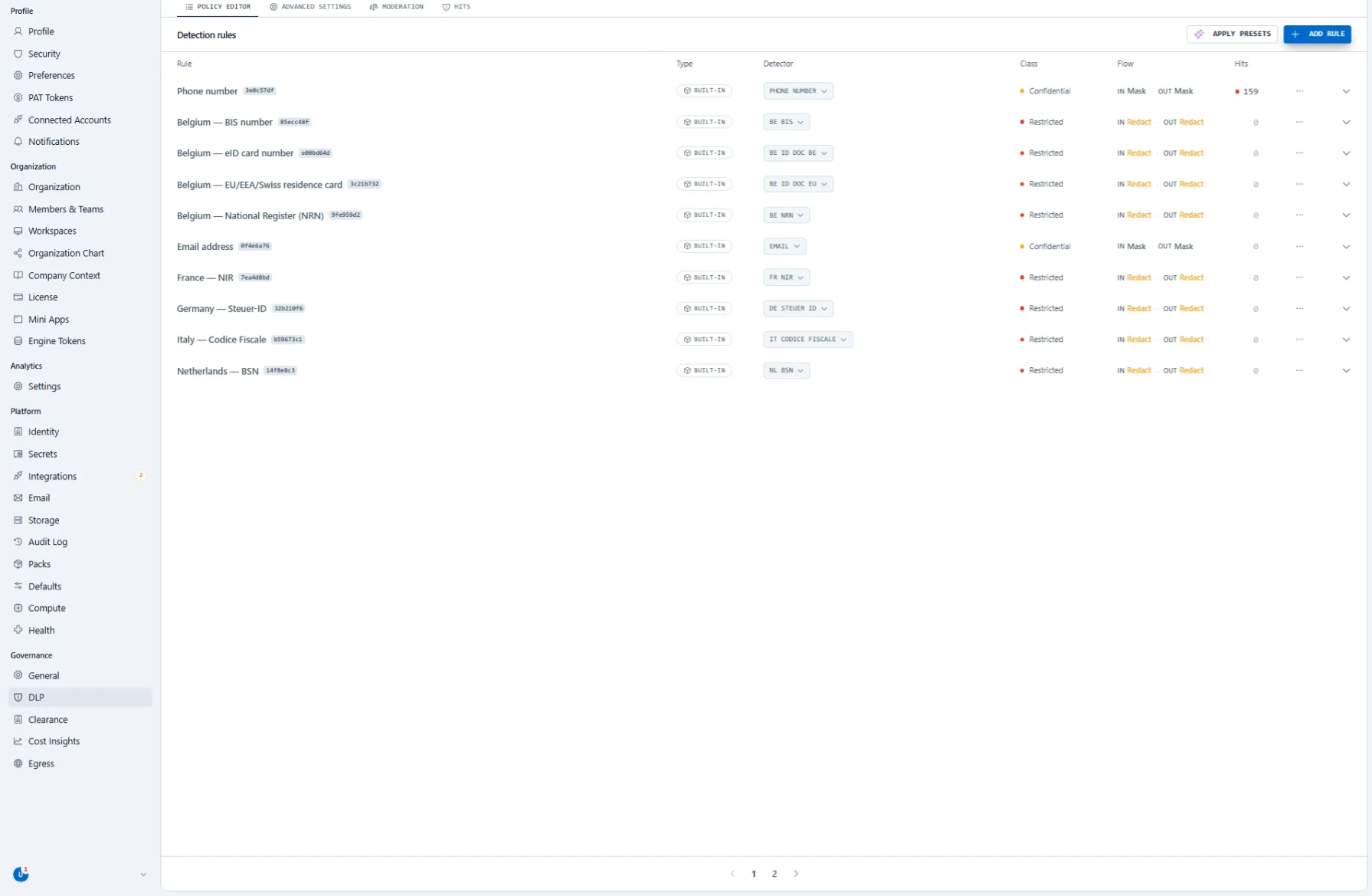
Detection rules in the policy editor: what is detected, how it is classified, what happens to it inbound and outbound — and how often each rule has fired.
Content is one half of the question; destination is the other. Egress policy governs where governed code may reach on the way out — a sandboxed notebook, an agent running code, a reviewed integration. The default is that nothing leaves: outbound traffic is denied until a destination is named, and the allowed set is edited in one place and applied to the next governed execution rather than negotiated project by project.
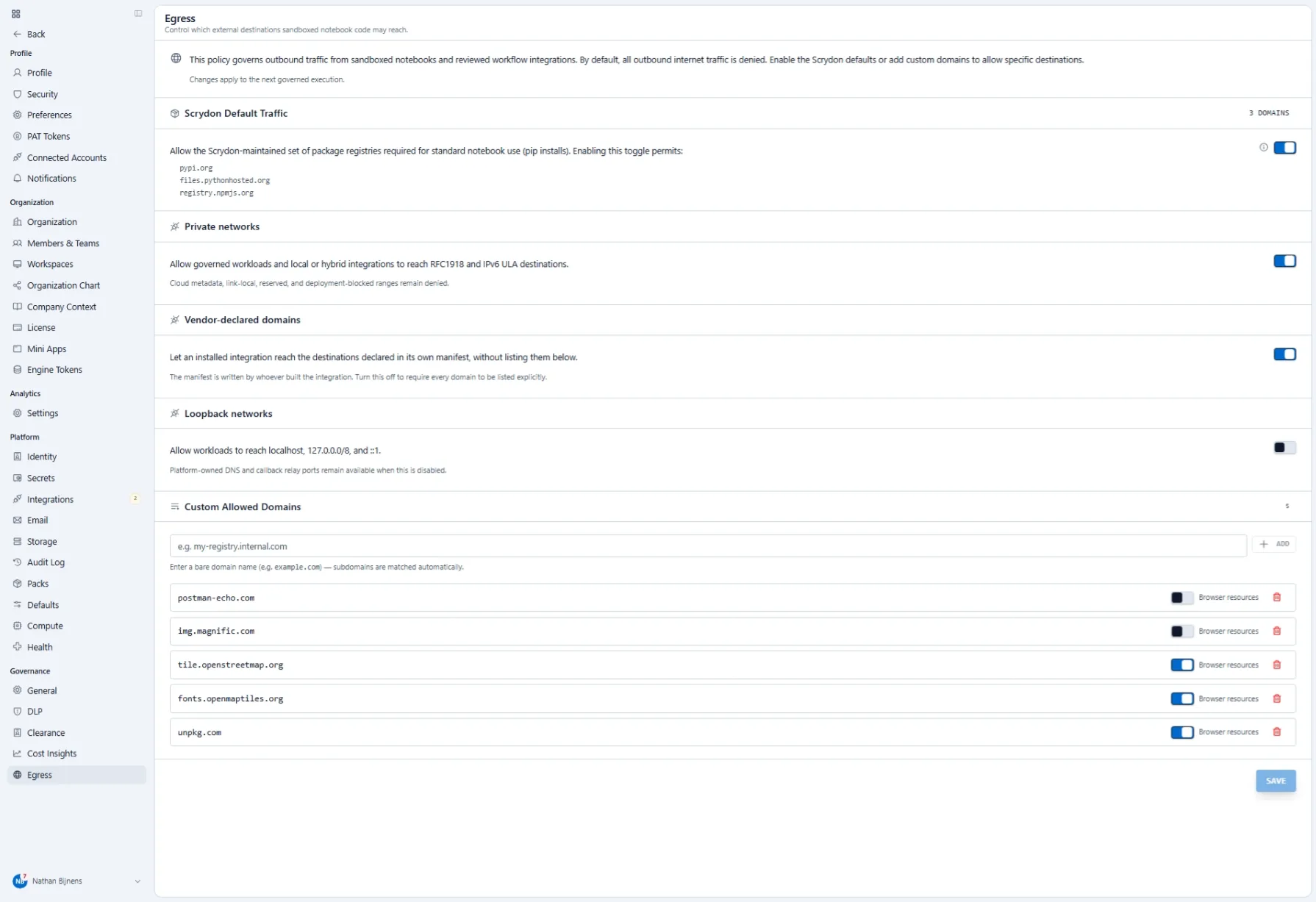
Egress policy: deny by default, then name what may be reached. Cloud metadata, link-local and reserved ranges stay denied whatever else is enabled, and compute access and browser access are separate switches rather than one blanket allowance.
The other half of a control is what happens when it bites. A blocked request is not a silent failure or an unexplained error: the person running the workload is told which hosts the policy refused, which switch governs them, and who can change it — so the answer to "why did this not load" is on the screen rather than in a ticket.
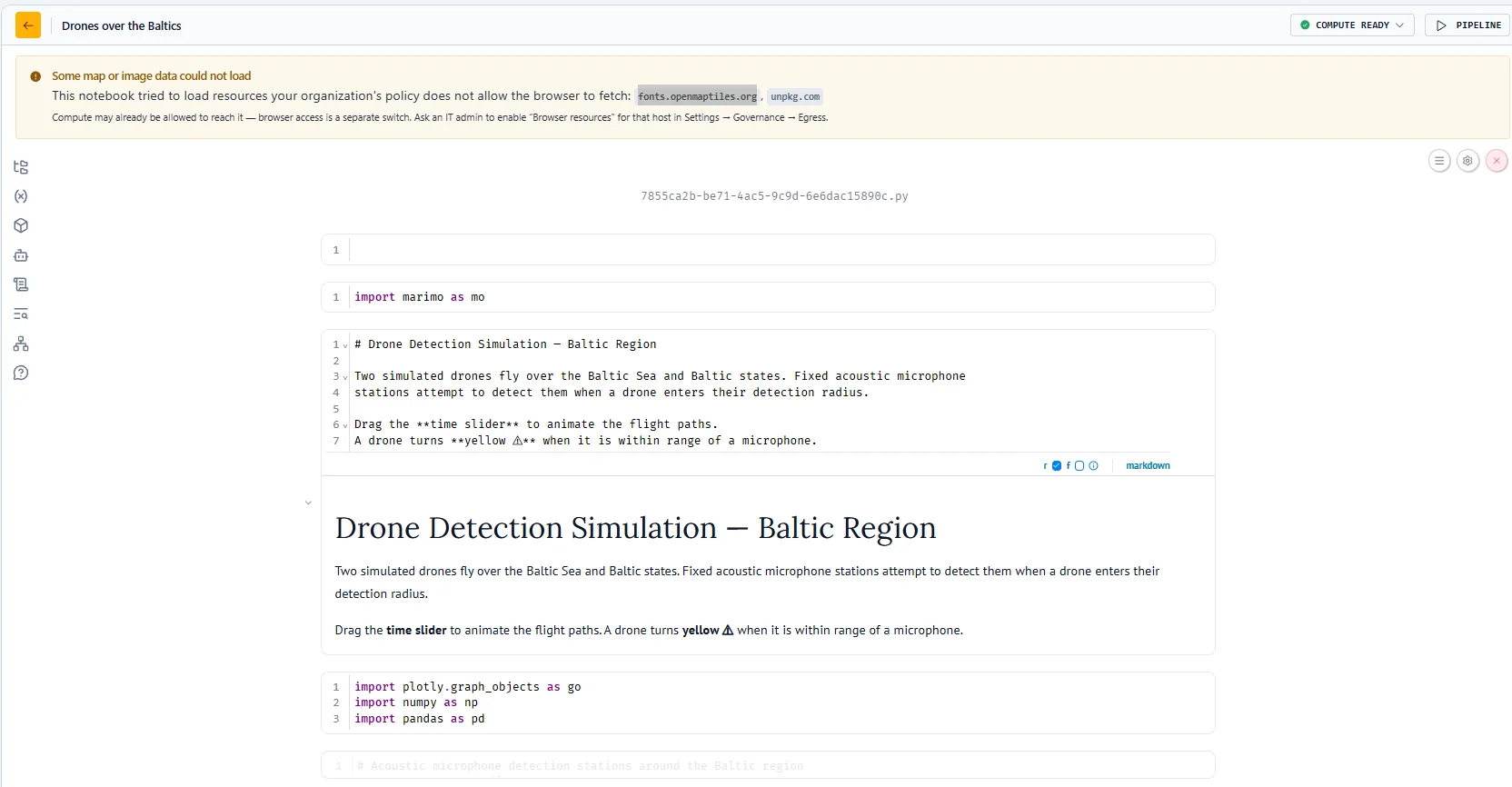
The same policy seen from inside a workload: exactly which destinations were refused, why, and where the decision is made. Enforcement that explains itself is what keeps people from routing around it.
Environments are part of the platform rather than something assembled around it. A workflow moves from development to staging to production by promotion, each stage gated behind the one before it, with no second toolchain to stand up and govern separately. Every promotion is stamped with a version, a time and the person who made it; each stage declares the identity its runs execute under; and the history is also the rollback path. Exposure is a separate, deliberate act — publishing an agent endpoint or a hosted form is its own decision, and it states which stage it serves.
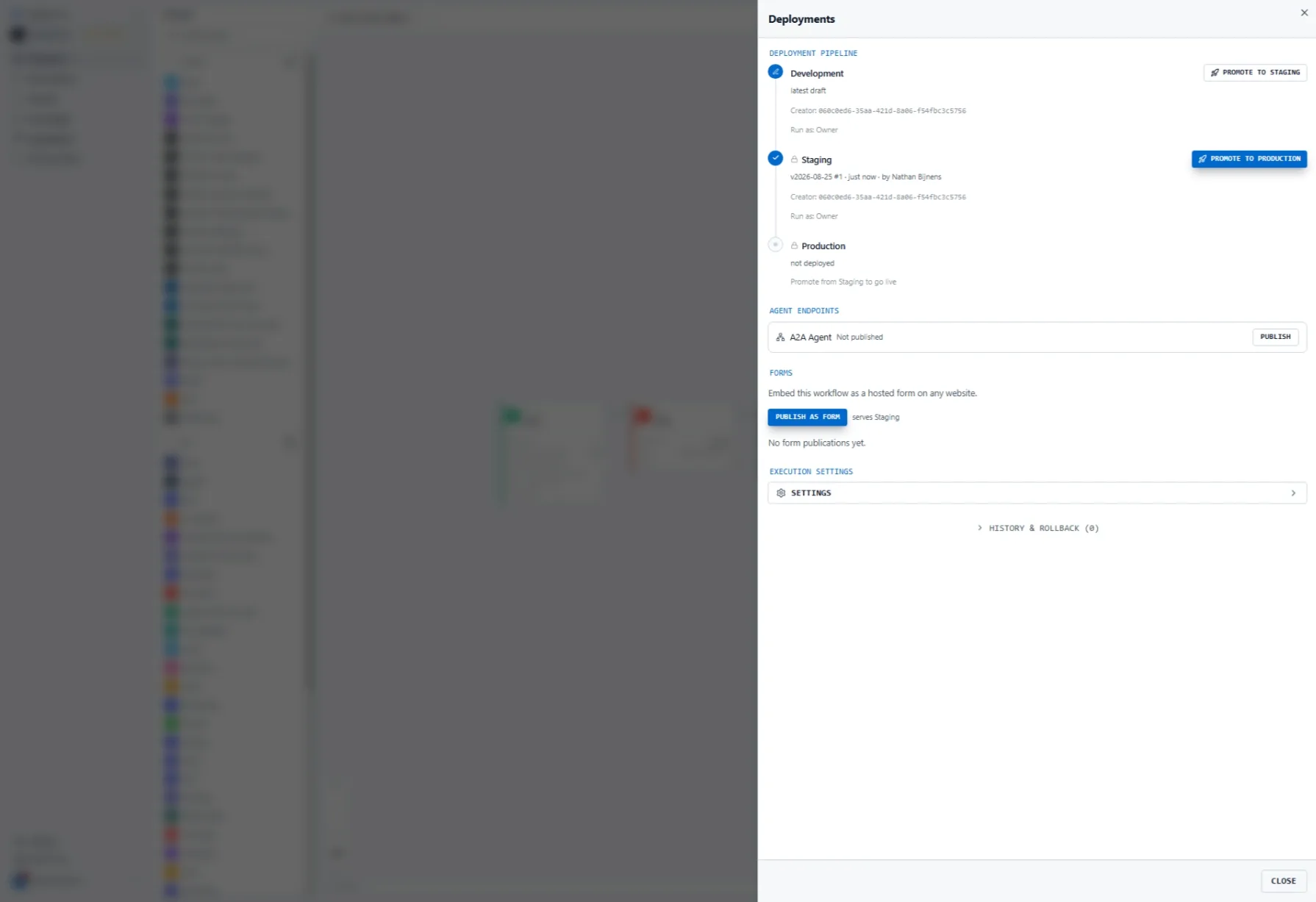
Promotion is the only way forward: development, then staging, then production — each step versioned, attributed and reversible, and each stage naming the identity it runs as. Nothing reaches production because someone deployed it from a laptop.
Data loss prevention — A DLP guardrails engine scans outputs for PII and hallucination and enforces regex / JSON validation gates before anything leaves.
Policy-as-code — A single policy decision point (Rego) authorises every action consistently across the app- and data-planes.
Scoped identity & access — A three-tier model — organisation roles, workspace membership, and team grants — gives every user and agent least-privilege access.
Immutable audit — Every action is logged immutably and queryably, with full actor and IP context, redacting sensitive fields.
Your keys — LOCAL, BYOK, or HYOK key strategies let you decide where encryption keys live; credentials are encrypted at rest and redacted in logs.
Fail-closed by default — If a request is invalid or unauthorised, it is denied rather than allowed — safe defaults everywhere.
Your data, your models, your call
Governance should mean control, not just paperwork. The AI OS keeps the organisation in command of exactly how AI touches its data: external AI vendors are reached only when you explicitly opt in, sensitive content is screened by DLP before it can leave, and you can keep humans in the loop wherever a decision warrants it — deterministic by default, agentic only where it earns its place. Everything runs inside your perimeter with keys you hold.
Speed without surrender. Autonomy for agents does not mean loss of control for you: you delegate execution, never authority.
- You decide what AI decides. Agents act only inside the policies you set; judgment calls, and the map of who decides what, stay with your people.
- You see everything. Every human and agent action is recorded as a typed, auditable event — ask "why did this happen?" and get a full answer.
- You set the boundaries. Role-based, jurisdiction-aware access, your encryption keys, your data-loss controls. Data never moves beyond your rules.
- You can always stop it. Any workflow can be paused or halted, and the platform fails closed rather than open. Nothing runs in your organisation that you cannot stop.
Control isn't the brake on AI — it's what lets you put your foot down.
Opt-in external AI — Frontier or third-party models are called only when you choose; by default nothing leaves your perimeter.
Human-in-the-loop — Insert approvals and human checkpoints into workflows wherever oversight is required.
Document clearance — Clearance and classification controls govern which data and documents AI can use.
Sovereign by default — Runs from air-gapped on-premises to cloud, so control never depends on where you deploy.
Compliance you can demonstrate
The platform maps its controls to the standards regulated organisations operate under — the EU AI Act, ISO 27001, ISO 42001, GDPR, SOC 2, SecNumCloud, NIST, the Cyber Resilience Act, and AIUC-1 — and produces framework evidence packs from the same audit and policy machinery that governs day-to-day operation. Compliance becomes a by-product of how the system runs, not a separate, manual exercise.
Frequently asked questions
What is AI governance and what does the platform provide?+
How does the platform help with EU AI Act compliance?+
What is the DLP (data loss prevention) capability?+
How do I stay in control of my data and which AI is used?+
How are AI agents governed?+
Which compliance frameworks does it map to?+
Is there a complete audit trail?+
Can we keep humans in the loop?+
Explore the platform
Prefer to write? Email hello [at] scrydon.com and we will get back to you.
Partners