SEAMLESS CONNECTIVITY · GOVERNED BY DEFAULT
Governed Integrations for Agents
An agent is only as useful as what it can reach. Open protocols and hundreds of pre-built connectors give yours that reach — with every connection governed like a user, never wired around the rules.
AI is only useful if it can reach the systems where the work actually happens. This is how the platform connects to them — hundreds of ready-made connections, plus open standards for everything else — with every connection subject to the same access rules a person would be.
Read this if you're mapping how AI would fit into an estate you already run.
AI OS integrations connect agents and AI workflows to the tools, systems, and data they need to act on — through the Model Context Protocol (MCP), Agent-to-Agent (A2A), and hundreds of pre-built connectors. Every connection runs under the platform's scoped identity, access control, and audit, so reach never becomes a governance gap.
The AI OS thrives on frontier connectivity. Agents pull context and take action across the enterprise tools and systems you already run — but without exposing your data: every connection is identity-scoped, policy-governed, and fully audited, so connectivity never opens a hole in your perimeter. No custom development needed — onboard new tools and systems in hours, not weeks, across FSI, healthcare, government, and defence.
MCP, A2A & Connectors
Agents plug into the Model Context Protocol, Agent-to-Agent protocols, and hundreds of pre-built connectors for enterprise tools and systems.
Governed by Default
Every connection runs under scoped identity, access control, and audit — so connectivity never becomes a governance gap.
Onboard in Hours
No custom development: connect new tools and systems in hours, not weeks, across FSI, healthcare, government, and defence.
Integrations in the Scrydon platform
One integrated, sovereign architecture. Here is where Integrations sits — highlighted against the full stack it works with.
The AI OS for Humans & AI Agents
Ontology & Semantic Layer, one connected model for your data, knowledge & processes
Combining the best of data lakes, data warehouses and search
Governed access to every model, and the agents & workflows that execute across your systems
Integrate across A2A, MCP, legacy systems and data sources
Secure domain federation, trusted data sharing, and cross-boundary intelligence
Sovereign Foundations
Integrations in depth
Pipelines
Broken processes live in the gaps between systems. The Integrations layer of the AI OS closes those gaps, connecting securely and seamlessly to the operational tools you already rely on.
We provide a vast library of built-in integrations for immediate connectivity to standard CRMs, databases, and enterprise applications.
To ensure maximum flexibility, the platform natively supports open standards—including OpenAPI, MCP, and A2A. This standard-first architecture makes it incredibly easy to build and deploy custom integrations, allowing the full platform to interact with any proprietary system or specialized tool within your infrastructure.
Reading this for a decision later?
Get the next change to European AI sovereignty, and what we learned building for it, in your inbox. A few times a year.
Agents act on real systems — under full governance
Integrations let agents pull context and take action across the tools your organisation already runs, without exposing your data. Every connection is brokered by the platform: the agent acts through a standard protocol or connector, but the AI OS decides whether its identity is allowed, screens what flows through, and records it. Reach and control are enforced together.
Connecting one is an administrative act, not an engineering project: pick it from the catalogue, choose how it authenticates, and it becomes available to workflows and agents under the same policy as everything else. Model providers are integrations too — including ones you host yourself — which is what makes the platform model-agnostic in practice rather than in principle.
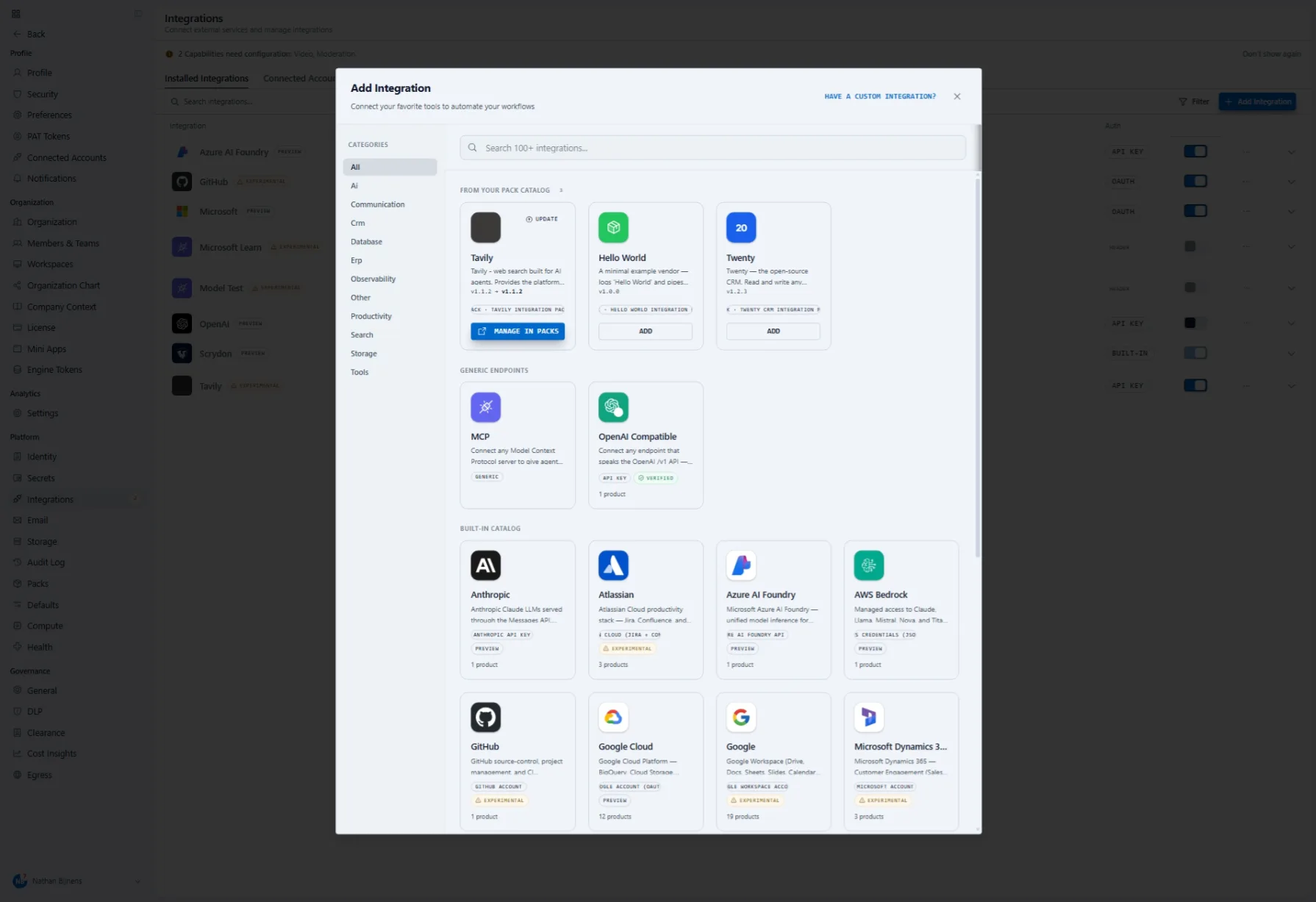
Three routes in one dialogue: what your packs brought with them, generic endpoints for anything speaking MCP or an OpenAI-compatible API, and the built-in catalogue — every entry declaring its authentication up front.
A pack goes a step further than a single connection: it bundles a whole capability into one versioned, installable unit — the ontology it needs, the workflows and process flows built on it, and the data sources that keep it current. Installing one is a single act rather than a project. The object types arrive with their link types, identity rules and bindings; the workflows arrive ready to deploy into a workspace; and the declared feeds begin polling on the schedule the pack states. Earlier catalogue versions stay listed, so an upgrade is something you can walk back.
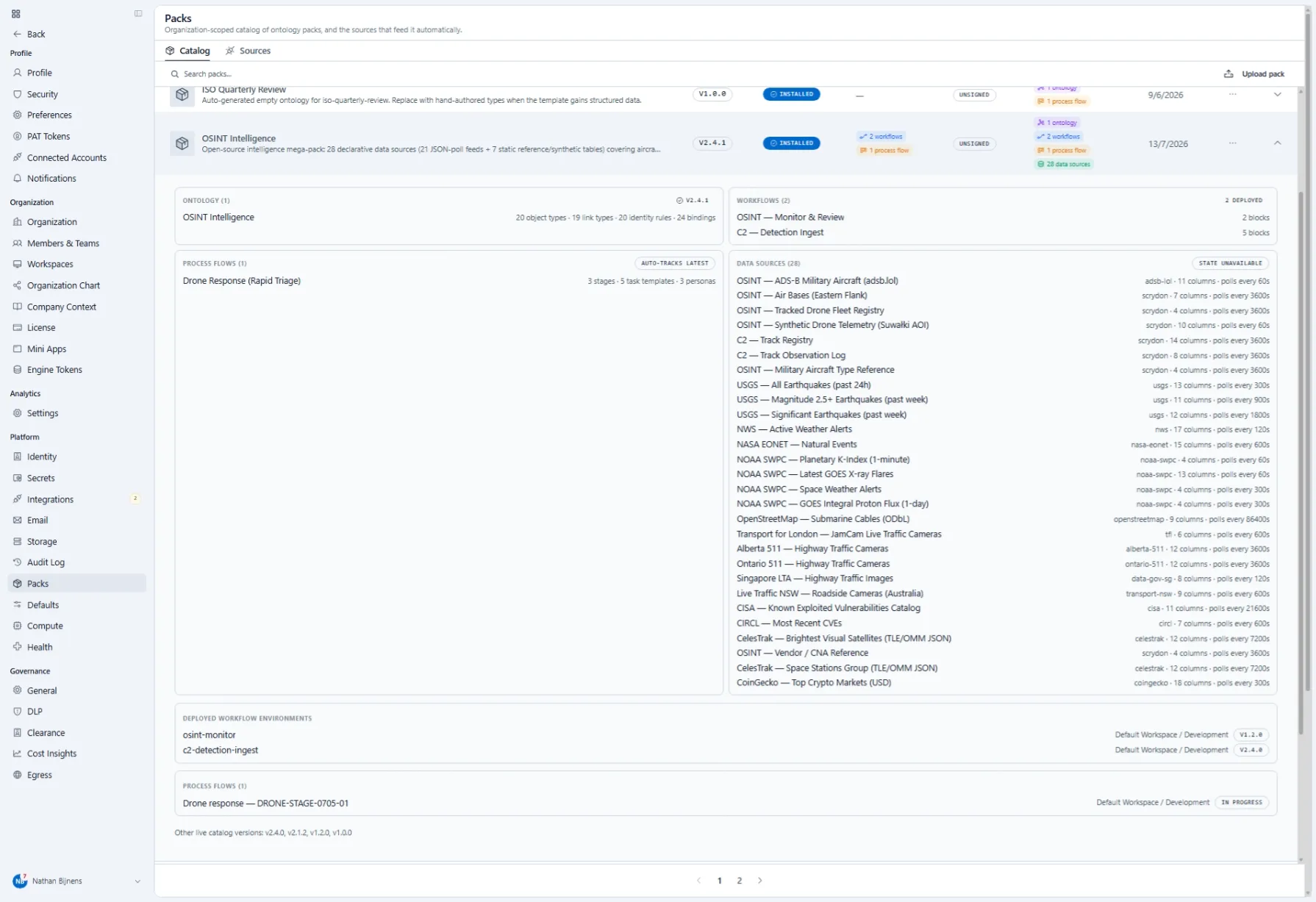
One pack, expanded: the ontology, the workflows and where they are deployed, the process flow with its stages and personas, and every feed with its refresh interval. A capability arrives as one versioned thing rather than a checklist someone has to reassemble.
Pre-built connectors — Hundreds of connectors for enterprise applications, systems, and data sources — no bespoke integration work per tool.
Open protocols — Native Model Context Protocol (MCP) and Agent-to-Agent (A2A) support, so agents reach tools and other agents through open standards.
Scoped identity & access — Every connection runs under a least-privilege identity, authorised by policy-as-code, fail-closed by default.
DLP & audit — Data loss prevention screens what passes through each integration, and every action is captured in an immutable audit trail.
Connectivity without a governance gap
Autonomous work is only useful if it can reach the applications it needs to act on — but every new connection is also a new way data can leave your control. The AI OS closes that gap: agents get the reach of open protocols and a deep connector library, while identity, access control, DLP, and audit on every connection keep that reach inside your perimeter, from air-gapped to cloud.
Frequently asked questions
What can the AI OS integrate with?+
How are integrations governed?+
Do integrations require custom development?+
Does connecting a tool expose my data?+
Explore the platform
Prefer to write? Email hello [at] scrydon.com and we will get back to you.
Partners